Quick answer
Web Design Agency vs Freelancer vs Template vs In-House
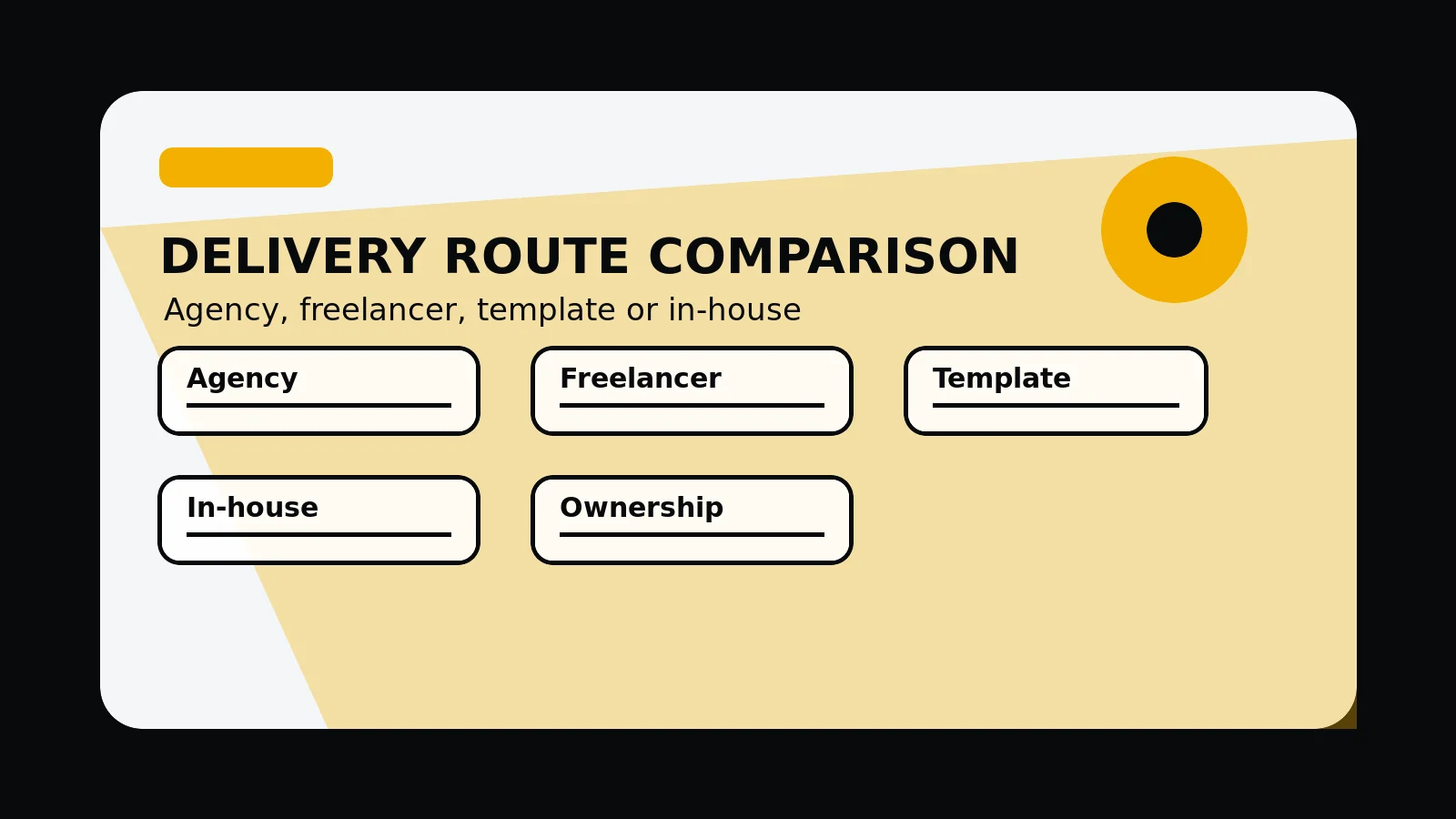
Choose between an agency, freelancer, template, or in-house team by asking who will own the full delivery risk. The right route depends on scope complexity, internal capacity, execution detail expectations, SEO needs, launch accountability, and future maintenance.
Choose the route by ownership
Choose a web design agency when the website needs one accountable delivery system. Choose a freelancer for narrow specialist scope, a template for simple low-risk pages, and in-house when the team already has the required skills and ownership.
A fair comparison starts by assigning responsibility for every part of the website, because the lowest headline cost can still leave the hardest work with the buyer.
Send the project responsibilities and we will identify which delivery route carries the least hidden risk.
Get a 3-point project reviewCompare responsibility before price
Score each route against the work it will actually own, then compare price only after the missing responsibilities are visible.
- Agency: best when strategy, design, build, SEO foundations, and QA need to connect
- Freelancer: best when the brief is narrow and internal ownership is strong
- Template: best when speed and cost matter more than custom structure
- In-house: best when skills, capacity, and launch accountability already exist
- Compare what is included after launch, not only the initial design
Inputs that make the comparison honest
Bring the documents below so each option can be judged against the same project reality rather than a generic sales pitch.
- Responsibility matrix
- Page architecture map
- Launch QA checklist
- Scope exclusions list
- Post-launch improvement route
Delivery route comparison
- Accountability: who owns strategy, content, design, build, SEO, QA, launch, and support.
- Complexity: page count, stakeholder count, supporting detail needs, integrations, migration, and review process.
- Control: how much custom structure, performance, accessibility, metadata, and component execution detail is needed.
- Capacity: whether internal people can brief, review, write, approve, and maintain the site.
- Longevity: what happens after launch when pages, offers, campaigns, and tracking need to change.
Common mistakes to avoid
- Choosing the cheapest route before assigning ownership for the work that still has to happen.
- Using a template for a project that needs custom page architecture, supporting detail, SEO, and QA.
- Hiring a freelancer for broad delivery without giving them internal strategy, content, and launch support.
What 760 Studios would review first
- Which route fits the actual scope
- What internal ownership is missing
- Which risks are hidden in the chosen option
Questions this article answers
When is a web design agency the better route?
An agency is usually better when strategy, page structure, copy direction, design, development, SEO foundations, QA, and launch management need one accountable delivery system.
When does a freelancer make sense?
A freelancer can work well when the brief is narrow, ownership is plain, and the business already has strategy, content, design direction, review, and launch support covered.
When is a template website enough?
A template can be enough for a simple, low-risk site where speed and cost matter more than custom architecture, supporting detail presentation, technical control, and long-term SEO growth.
What makes in-house delivery risky?
In-house delivery becomes risky when the team has partial skills but no plain owner for content, frontend execution detail, search foundations, accessibility, forms, hosting, and production launch.